Source: http://www.nrk.no/nyheter/verden/1.7991838
See the original link for Sidsel Wold’s own photos of daily life in Iran.
- Michael Jackson's death devastated the green spring
We are sitting at an undisclosed location in Tehran, three young Iranian men in their twenties and me.
- Michael Jackson's death devastated the green spring, Babak sighs. A quiet nodding goes around the table in the café's darkest corner.
ABOUT NAMING AND use of pictures
Fearing trouble with the regime the three men in this article only wanted to reveal their first names. They did not want to be photographed.
The owner of the cafe also would not risk trouble by openly allowing Western journalists to do interviews in his premises.
The atmosphere is strained.
All three have just told me that they would prefer to leave Iran. That they see no future here now.
Babak has visited the British Consulate for two years to ask for a residence permit, but in vain.
Want the neighbour to rebel
- I just want to leave this country. I am desperately trying to get away from here, says Babak, who hopes to take a PhD abroad.
Borna would prefer to go to Europe or Canada, but not forever. He hopes that Iran will undergo changes while he lives abroad.
The others laugh. For here we are at the core. Everyone seems to want the neighbour to rebel.
Are dissatisfied Iranians not ready to go out into the streets themselves, as the Syrians do? I ask.
This was how the uprising after the controversial counting after the presidential election in 2009 ended.
When the Basij militia began using sharp ammunition on people in the streets, the protesters stayed at home.
In Iran, I'm trying to figure out what had become of the green movement and where all the students who participated are now.
Some have travelled abroad. Others continue with their lives and hope for the best.
Several are sitting in cafes like these young men, being depressed.
Not enough to lose yet
All shake their heads over the blood bath in Syria. It is cruel.
- Assad cannot survive this. Eventually, all dictators will fall, Borna thinks.
- We Iranians are somewhere between Syria and Europe, says Sina.
- We do not have enough to lose yet, so we do not demonstrate with our lives on the stake, as the Syrians are doing. But we're not as civilized as the Europeans, he says.
- Do you dream of a good future in Iran? I ask.
- Maam, I am just hopeless just now, Babak repeats sorrowful.
- We all live in social depression, says the three.
- Have no Mandela
One of them is an accountant, the other a musician, the third an engineer.
They are in their prime of life and an example of the brain drain that has afflicted the Islamic Republic for decades, but that reached a new peak after the 2009 elections.
But change will come, they believe. The collective depression here cannot continue as it is now.
Sina does not want a revolution, just reforms. Babak believes it is appropriate to impose sanctions on Iran in order to put pressure on the mullah regime.
- But the sanctions also affect the people. It has become dangerous to fly now. Iranian aircrafts cannot find spare parts, and are often affected by technical errors.
- I wish Russia and China did not support us. It would be better to be completely isolated, and force a crisis that would lead to a change.
- If sanctions were imposed like in South Africa? Asks Sina as to vent the thought.
- No, we have no Mandela. Our hope for change and reform has no leader.
- A warning for the regime
What do the three think about the Arab spring?
- The Arab uprising is a warning to the Iranian regime. Sina says.
- The Arab spring does not help me, Babak interrupts.
- Why did the West not help us in 2009, when the uprising began here? We were at it, but then Michael Jackson destroyed everything. When he died the world press went out of its wits and broadcasted nothing else. The world forgot Iran altogether. Why did Michael Jackson die just when we finally stood up against the regime? Borna sighs.
They look down at the table. Sina lights another cigarette.
We have to go. It is clear that neither the guests in the cafe nor the owner feel comfortable with the presence of foreign journalists.
When we walked out it was like a sigh of relief closed the door behind us.
Showing posts with label Iran. Show all posts
Showing posts with label Iran. Show all posts


9 February 2012
Darkness at noon – A report from Iran by NRK’s correspondent Sidsel Wold
Source http://www.nrk.no/nyheter/verden/1.7987844
(See the original page for Sidsel Wold’s own photos from Iran, as I do not want to copy them here.)
Sidsel Wold was met with fear, rejection and blocked websites in Iran
NRK's Sidsel Wold just returned to Tehran, two and a half years since her last visit. She found a quite different and gloomier place, where everyone was afraid and no one opened their mouth.
(See the original page for Sidsel Wold’s own photos from Iran, as I do not want to copy them here.)
Sidsel Wold was met with fear, rejection and blocked websites in Iran
NRK's Sidsel Wold just returned to Tehran, two and a half years since her last visit. She found a quite different and gloomier place, where everyone was afraid and no one opened their mouth.
With the shawl pulled over her head NRK’s former Middle East correspondent went back to Tehran to report from one of the world’s most combustible areas. There she met closed doors, frightened people and blocked websites.
In this article Sidsel Wold shares her experiences from six days in Tehran with the readers.
Wold’s title for her story from Iran, "Darkness at noon", is not randomly chosen.
It is the same title as Arthur Koestler's famous novel from 1940, where he reveals the horrors of Stalinism in the Soviet Union.
Sidsel Wold was a tour guide in the Soviet Union when she was young, and she draws this comparison when she describes today's Iran.

Finally I was going to Iran again!
After two years of visits and tea drinking in the Iranian Embassy in Oslo, I was able to collect my prize: The press visa.
In this article Sidsel Wold shares her experiences from six days in Tehran with the readers.
Wold’s title for her story from Iran, "Darkness at noon", is not randomly chosen.
It is the same title as Arthur Koestler's famous novel from 1940, where he reveals the horrors of Stalinism in the Soviet Union.
Sidsel Wold was a tour guide in the Soviet Union when she was young, and she draws this comparison when she describes today's Iran.

Darkness at noon
Finally I was going to Iran again!
After two years of visits and tea drinking in the Iranian Embassy in Oslo, I was able to collect my prize: The press visa.
But in the weeks prior to departure I strongly felt that Tehran had become a different and gloomier place.
The last time I was in this metropolis of 14 million people was during the elections in 2009.
In the days before the polling stations opened, a green Iranian spring blossomed. People were out in the streets screaming and shouting out their opinion. Most of them demanded reforms.
The Opposition’s presidential candidates, Mir Hossein Mousavi and Mehdi Karroubi, were likely to do well.
But when the votes were counted, another man was the election’s big winner: President Mahmoud Ahmadinejad.
Closed the ancient Persia
In Tehran's streets the news was met with shock and disappointment. And much anger.
It was not long before hundreds of thousands protested in the streets against an election result they believed to be manipulated.
After several days of mass demonstrations, the Basij militia went from beating with clubs, to shooting with sharp ammunition. The Basijs are paramilitary hooligans who are paid by the regime to beat up citizens who create unrest.
Several people were shot and killed in broad daylight. One was the 16-year-old Neda, the icon of the regime's brutal use of force against young Iranians.
Right after Iran's disputed election count, the regime closed the country to foreign news agencies.
Since then there has hardly been any Western journalists there. Darkness descended on the ancient Persia.
Pulled the shawl over my hair
To return to Iran was a dream. The Iranians are a great and proud people that we should listen to.
In my opinion, the demonization of the entire Iran because of the acrimonious dispute with the West is unfortunate.
So I pulled the shawl over my hair, and began to work to show other sides of the country.
Need permission to film
I was happy when I finally could walk through the door to Ivansahars premises.
Ivansahar is a media agency we have worked with several times in the past, because journalists cannot work here quite the way we want to.
We need permission to film, and Ivansahar also sets up interview appointments for us.
One month prior to departure, I had sent my booking request list:
Something was wrong
But when I came into the office I realized that something was wrong. The lights were out, only one employee was left.
They had fired their three employees, and the boss had left Iran. Since no press people get a visa to Iran anymore, they had partially closed down the office.
But now Ivansahars sole employee had only NRK to deal with, so I was optimistic.
NRK blocked – Yr open
In the small hotel Karoon internet was quite OK, except that NRK, Dagbladet, Facebook, Twitter, YouTube and BBC was blocked.
I could read Tehran Times, Iran's Press TV, Aftenposten, VG-nett and yr.no. *
And with Yahoo, I could send home both radio material and mail.
- Western Zionist media
Then the days went by without any interview appointments.
Several times a day I called Ivansahar. Had we been given permission? Appointments?
- No, unfortunately. Or: Noone answers. Or: The answer is no.
The family of a liquidated nuclear physicist replied that they do not speak to Western Zionist media.
Could only film our own cakes
Day after day we moved at a snail's pace, caught in Tehran's eternal traffic jams.
Since the appointments did not materialize, we had to try and ask for filming permission ourselves, in shops, cafes etc.
When we finally arrived, we were often given the same answer: No, you cannot film here.
A cafe owner said that yes indeed, we could film at his place later in the day when there were more people around the tables.
But when we came in with the camera, the mood quickly changed. The cafe guests became restless, they looked anxiously around as if a storm was approaching.
The only thing we were able to film there was our own slices of cake and coffee cups.
Voices disappeared and silenced
Before 2009 we had at least two, often three to four appointments each day. We filmed in cafes, in shopping centres, and could interview people without problems.
Before 2009 an interpreter took me to the regime-critical journalist Issa Saharkiz, the reformists Ali Abtahi and the dissident Ibrahim Yazdi.
- Why do you take me to these critics? I asked the interpreter, who obviously was engaged by Iran's ministry of culture and Islamic guidance.
- Because it is important to show the range of opinions here, so you get the whole picture, said the interpreter.
Another exciting source was Sayed Hussein Adeli, former ambassador of Iran in the United Kingdom.
Now all four of them were out of reach. Their voices are silenced and vanished.
Saharkiz is in prison. Abtahi was imprisoned, then turned up on TV 15-20 kilos lighter admitting that he had been wrong.
Ibrahim Yazdi, aged 81, was imprisoned after 2009, and later put under house arrest. Adeli has not given interviews in two years, I was told. All four participated in the Islamic revolution in 1979.
Yazdi was even with Ayatollah Khomeini on the historic flight from Paris to Tehran after the Shah's fall.
Now they are all gagged. The revolution seems to eat its own children.
The Street, The Grand Bazaar and the ski slopes
During the week we only received three permissions:
Became nervous myself
We also had some luck. One day, an Iranian television reporter came over to us on the street.
His team filmed us, as if he wanted to show the viewers of the Iranian state TV channel IRIB that, yes, here is full press freedom for western journalists.
But when he wanted to interview me, I quickly said that we had to interview him instead.
Of course, smiled the confident, smiling man; of course, we could interview him.
I was nervous at the thought of being interviewed by Iranian TV. Because I did not want to say what I really mean.
And I realized why so few would talk to NRK ...
Memories from the USSR
When I was young I worked as a tour guide in the USSR. Memories from that time resurfaced now.
Like the Soviets, the Iranians are also afraid to speak now. Some wrote on a sheet of paper instead of talking for fear of spies or microphones.
It was like a clammy hand had tightened its grip on the entire community.
Everyone wants U.S. dollars
And then there was the money riyal. During the Soviet era the rubel was a non-convertible currency.
Everyone wanted only the great Satan’s money: The dollar.
At the Imam Khomeini International Airport, I experienced the same thing:
I wanted to exchange my Iranian riyals, which are not convertible in the West any more.
Because of inflation the Iranian currency had so many zeros that I no longer understand any of them, and I wanted to exchange them. But no, the banks at the airport did not want them back.
- Why do you not want your own money, I asked annoyed.
- Only those with Iranian passports can exchange riyal, was the answer.
The Western world is boycotting the Iranian central bank. So maybe this is tit for tat...
* Dagbladet, Aftenposten and VG are Norwegian newspapers. YR.no is the popular Norwegian weather forecast-site.
The last time I was in this metropolis of 14 million people was during the elections in 2009.
In the days before the polling stations opened, a green Iranian spring blossomed. People were out in the streets screaming and shouting out their opinion. Most of them demanded reforms.
The Opposition’s presidential candidates, Mir Hossein Mousavi and Mehdi Karroubi, were likely to do well.
But when the votes were counted, another man was the election’s big winner: President Mahmoud Ahmadinejad.
Closed the ancient Persia
In Tehran's streets the news was met with shock and disappointment. And much anger.
It was not long before hundreds of thousands protested in the streets against an election result they believed to be manipulated.
After several days of mass demonstrations, the Basij militia went from beating with clubs, to shooting with sharp ammunition. The Basijs are paramilitary hooligans who are paid by the regime to beat up citizens who create unrest.
Several people were shot and killed in broad daylight. One was the 16-year-old Neda, the icon of the regime's brutal use of force against young Iranians.
Right after Iran's disputed election count, the regime closed the country to foreign news agencies.
Since then there has hardly been any Western journalists there. Darkness descended on the ancient Persia.
Pulled the shawl over my hair
To return to Iran was a dream. The Iranians are a great and proud people that we should listen to.
In my opinion, the demonization of the entire Iran because of the acrimonious dispute with the West is unfortunate.
So I pulled the shawl over my hair, and began to work to show other sides of the country.
Need permission to film
I was happy when I finally could walk through the door to Ivansahars premises.
Ivansahar is a media agency we have worked with several times in the past, because journalists cannot work here quite the way we want to.
We need permission to film, and Ivansahar also sets up interview appointments for us.
One month prior to departure, I had sent my booking request list:
- Film in a bank, and talk to the bank manager about the currency crisis.
- Talk with a family about how the sanctions affect their daily lives.
- Talk to nuclear physicists about how the liquidation of their peers has influenced them.
- Talk to MPs about possible sanctions against the EU.
- Visit friends of former prime minister Mossadeq who was overthrown by CIA and British intelligence in 1953.
- Interview analysts and economists.
- If possible: talk to people from the green movement ...?
- Take pictures in slalom slopes.
Something was wrong
But when I came into the office I realized that something was wrong. The lights were out, only one employee was left.
They had fired their three employees, and the boss had left Iran. Since no press people get a visa to Iran anymore, they had partially closed down the office.
But now Ivansahars sole employee had only NRK to deal with, so I was optimistic.
NRK blocked – Yr open
In the small hotel Karoon internet was quite OK, except that NRK, Dagbladet, Facebook, Twitter, YouTube and BBC was blocked.
I could read Tehran Times, Iran's Press TV, Aftenposten, VG-nett and yr.no. *
And with Yahoo, I could send home both radio material and mail.
- Western Zionist media
Then the days went by without any interview appointments.
Several times a day I called Ivansahar. Had we been given permission? Appointments?
- No, unfortunately. Or: Noone answers. Or: The answer is no.
The family of a liquidated nuclear physicist replied that they do not speak to Western Zionist media.
Could only film our own cakes
Day after day we moved at a snail's pace, caught in Tehran's eternal traffic jams.
Since the appointments did not materialize, we had to try and ask for filming permission ourselves, in shops, cafes etc.
When we finally arrived, we were often given the same answer: No, you cannot film here.
A cafe owner said that yes indeed, we could film at his place later in the day when there were more people around the tables.
But when we came in with the camera, the mood quickly changed. The cafe guests became restless, they looked anxiously around as if a storm was approaching.
The only thing we were able to film there was our own slices of cake and coffee cups.
Voices disappeared and silenced
Before 2009 we had at least two, often three to four appointments each day. We filmed in cafes, in shopping centres, and could interview people without problems.
Before 2009 an interpreter took me to the regime-critical journalist Issa Saharkiz, the reformists Ali Abtahi and the dissident Ibrahim Yazdi.
- Why do you take me to these critics? I asked the interpreter, who obviously was engaged by Iran's ministry of culture and Islamic guidance.
- Because it is important to show the range of opinions here, so you get the whole picture, said the interpreter.
Another exciting source was Sayed Hussein Adeli, former ambassador of Iran in the United Kingdom.
Now all four of them were out of reach. Their voices are silenced and vanished.
Saharkiz is in prison. Abtahi was imprisoned, then turned up on TV 15-20 kilos lighter admitting that he had been wrong.
Ibrahim Yazdi, aged 81, was imprisoned after 2009, and later put under house arrest. Adeli has not given interviews in two years, I was told. All four participated in the Islamic revolution in 1979.
Yazdi was even with Ayatollah Khomeini on the historic flight from Paris to Tehran after the Shah's fall.
Now they are all gagged. The revolution seems to eat its own children.
The Street, The Grand Bazaar and the ski slopes
During the week we only received three permissions:
- To film in the street and in the bazaar.
- To film in the slopes.
- To interview the spokesman for the Iranian Foreign Ministry.
Became nervous myself
We also had some luck. One day, an Iranian television reporter came over to us on the street.
His team filmed us, as if he wanted to show the viewers of the Iranian state TV channel IRIB that, yes, here is full press freedom for western journalists.
But when he wanted to interview me, I quickly said that we had to interview him instead.
Of course, smiled the confident, smiling man; of course, we could interview him.
I was nervous at the thought of being interviewed by Iranian TV. Because I did not want to say what I really mean.
And I realized why so few would talk to NRK ...
Memories from the USSR
When I was young I worked as a tour guide in the USSR. Memories from that time resurfaced now.
Like the Soviets, the Iranians are also afraid to speak now. Some wrote on a sheet of paper instead of talking for fear of spies or microphones.
It was like a clammy hand had tightened its grip on the entire community.
Everyone wants U.S. dollars
And then there was the money riyal. During the Soviet era the rubel was a non-convertible currency.
Everyone wanted only the great Satan’s money: The dollar.
At the Imam Khomeini International Airport, I experienced the same thing:
I wanted to exchange my Iranian riyals, which are not convertible in the West any more.
Because of inflation the Iranian currency had so many zeros that I no longer understand any of them, and I wanted to exchange them. But no, the banks at the airport did not want them back.
- Why do you not want your own money, I asked annoyed.
- Only those with Iranian passports can exchange riyal, was the answer.
The Western world is boycotting the Iranian central bank. So maybe this is tit for tat...
* Dagbladet, Aftenposten and VG are Norwegian newspapers. YR.no is the popular Norwegian weather forecast-site.
14 November 2011
Nine months in house arrest
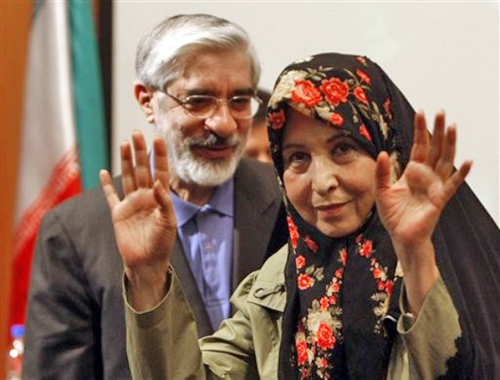
Today the leaders of Iran’s Green opposition movement, Mir Hussein Mousavi, his wife Zarah Rahnavard and Mehdi Karroubi, have spent exactly nine months under strict house arrest.
In the beginning Karroubi’s wife, Fatemeh, was also kept under house arrest. She was however temporarily released this summer due to health problems. As far as I know she is now back in house arrest again.


In the beginning Karroubi’s wife, Fatemeh, was also kept under house arrest. She was however temporarily released this summer due to health problems. As far as I know she is now back in house arrest again.

8 March 2011
Live-blogging #17Esfand - 8 March, International Women’s Day - in Iran
There doesn’t seem to be as many live blogs active today as there was one week ago. But since the Green movement has announced protests for today (every Tuesday until the Iranian new year, or Norouz), I’ll link the blogs I have found below.
Also follow my live-blogger Twitter list
Enduring America (English - Scott Lucas)
Dissected News (James Miller)
MARDOMAK liveblog (Farsi)
RAHANA News Agency (Farsi)
Please notify me of other blogs.
Also follow my live-blogger Twitter list
Enduring America (English - Scott Lucas)
Dissected News (James Miller)
MARDOMAK liveblog (Farsi)
RAHANA News Agency (Farsi)
Saeed Valadbaygi:
Please notify me of other blogs.
.
20 February 2011
Live-blogging #1Esfand - 20 February protests in Iran
The following blogs are live blogging the #1esfand protests in Iran today:
Enduring America (Scott Lucas)
RAHANA (Human Rights House Of Iran)
- In English
- In Farsi
Iran News Now (Dave Siavashi)
Dissected News (James Miller)
Tehran Bureau (Dan Geist, Josh Shahryar)
Mardomak (farsi)
Revolutionary Road (English & Farsi - Saeed Valadbaygi)
Persian to English
Please use the comment field to notify me of other blogs.
Also follow my live-bloggers list on Twitter: http://twitter.com/kiraber/live-bloggers
.
Enduring America (Scott Lucas)
RAHANA (Human Rights House Of Iran)
- In English
- In Farsi
Iran News Now (Dave Siavashi)
Dissected News (James Miller)
Tehran Bureau (Dan Geist, Josh Shahryar)
Mardomak (farsi)
Revolutionary Road (English & Farsi - Saeed Valadbaygi)
Persian to English
Please use the comment field to notify me of other blogs.
Also follow my live-bloggers list on Twitter: http://twitter.com/kiraber/live-bloggers
.
13 February 2011
Live blogging #25Bahman - 14 February protests in Iran
The information flow on Twitter can be very overwhelming when a protest is on in Iran. Some experienced journalist twitterers (tweeple) however are often live blogging the events. Followng these people is a great help to navigate safely in the information flow.
You can follow my list on Twitter: http://twitter.com/kiraber/live-bloggers
- or you can follow the blogs here:
Iran News Now (Dave Siavashi)
Enduring America (Scott Lucas)
Tehran Bureau (Josh Sharyar, Muhammad Sahimi and others)
Dissected News (James Miller)
Street Journalist (Saeed Valadbaygi)
Homylafayette Iran News in English (25 Bahman Scrapbook)
All blogs now linked to live blog page.
Please use the comment field to share info on other live bloggers who cover the events.
You can follow my list on Twitter: http://twitter.com/kiraber/live-bloggers
- or you can follow the blogs here:
Iran News Now (Dave Siavashi)
Enduring America (Scott Lucas)
Tehran Bureau (Josh Sharyar, Muhammad Sahimi and others)
Dissected News (James Miller)
Street Journalist (Saeed Valadbaygi)
Homylafayette Iran News in English (25 Bahman Scrapbook)
All blogs now linked to live blog page.
Please use the comment field to share info on other live bloggers who cover the events.
Subscribe to:
Posts (Atom)